


Quick answer
To test garage door balance, close the door, pull the release cord, lift the door by hand to about waist height and let go. A balanced door stays or drifts slightly. If it drops, spring tension is low or a spring has failed. If it rises, tension is too high. Never touch springs or cables.
Key takeaways
- Do the test with the door closed first, then release the opener with its cord and lift by hand to about waist height.
- A balanced door stays near where you leave it. A door that drops or rises is out of balance.
- Never touch the springs, the lifting cables or the bottom corner brackets. They are under load.
- A stiff door that still stays put usually has a friction problem in the tracks or rollers, not a spring problem.
- A door that drops fast, hangs crooked or has a slack cable is a technician job, not a DIY job.
Short answer: close the door, pull the release cord so the opener lets go, lift the door by hand to about waist height and let go slowly with your hands clear. A balanced door stays put or drifts a little. A door that drops has low spring tension or a failed spring. A door that rises has too much tension. Never touch the springs or cables.
Door or gate giving you trouble?
Call +971 50 495 3512 WhatsApp us Get a quote
Open 24/7 · Same-day technician · Free site visit
Why does garage door balance matter?
Because the springs, not the opener, carry the weight of a sectional door. A well balanced door feels light in the hand even when the panels are heavy. The opener only has to guide it up and down.
When the balance is off, the opener is asked to do the springs' job. It strains, runs hot, wears its gears and eventually trips on its force limit or reverses halfway. Many "my opener is dead" calls in Ajman and Sharjah turn out to be a door that has slowly gone out of balance. The motor was never the problem.
The test below takes three minutes and needs no tools. It tells you whether the problem is the springs, the moving parts, or something else. It does not fix anything, and it is not a replacement for a service visit.
How do I do the garage door balance test safely?
Do it with the door fully closed, so the door is at its lowest and cannot fall far. Keep your fingers away from the panel joints and the sides of the door. If you have a double door, ask a second person to stand clear and watch.
- Close the door with the opener or the wall button. Switch the opener off at the wall socket if you can reach it safely.
- Pull the red release cord hanging from the opener carriage. The door is now free of the motor.
- Stand in the middle of the door. Lift it by the bottom edge or a handle, to about waist height. It should lift without a struggle.
- Let go slowly and step back, hands clear of the panel joints. Watch for two or three seconds.
- Lower the door by hand to the floor. Do not let it drop.
- Re-engage the opener as the manual describes, usually by pulling the cord again or running the opener until the carriage clicks back in.
Stop the test and call a technician if
- The door is already crooked, off its track or hanging at an angle.
- A lifting cable is slack, frayed or has come off its drum.
- You can see a gap in a spring coil, or a spring is rusted through.
- The door is very heavy to lift, or it drops quickly when you let go.
- You hear a loud bang during the test.
Do not touch the springs above the door or the cable brackets at the bottom corners. They hold the full load of the door even when it is closed. Do not try to adjust a spring yourself. Our FAQ on what to do when a garage door spring breaks covers how to open a door safely in that case.
What does it mean if the door stays, drops or rises?
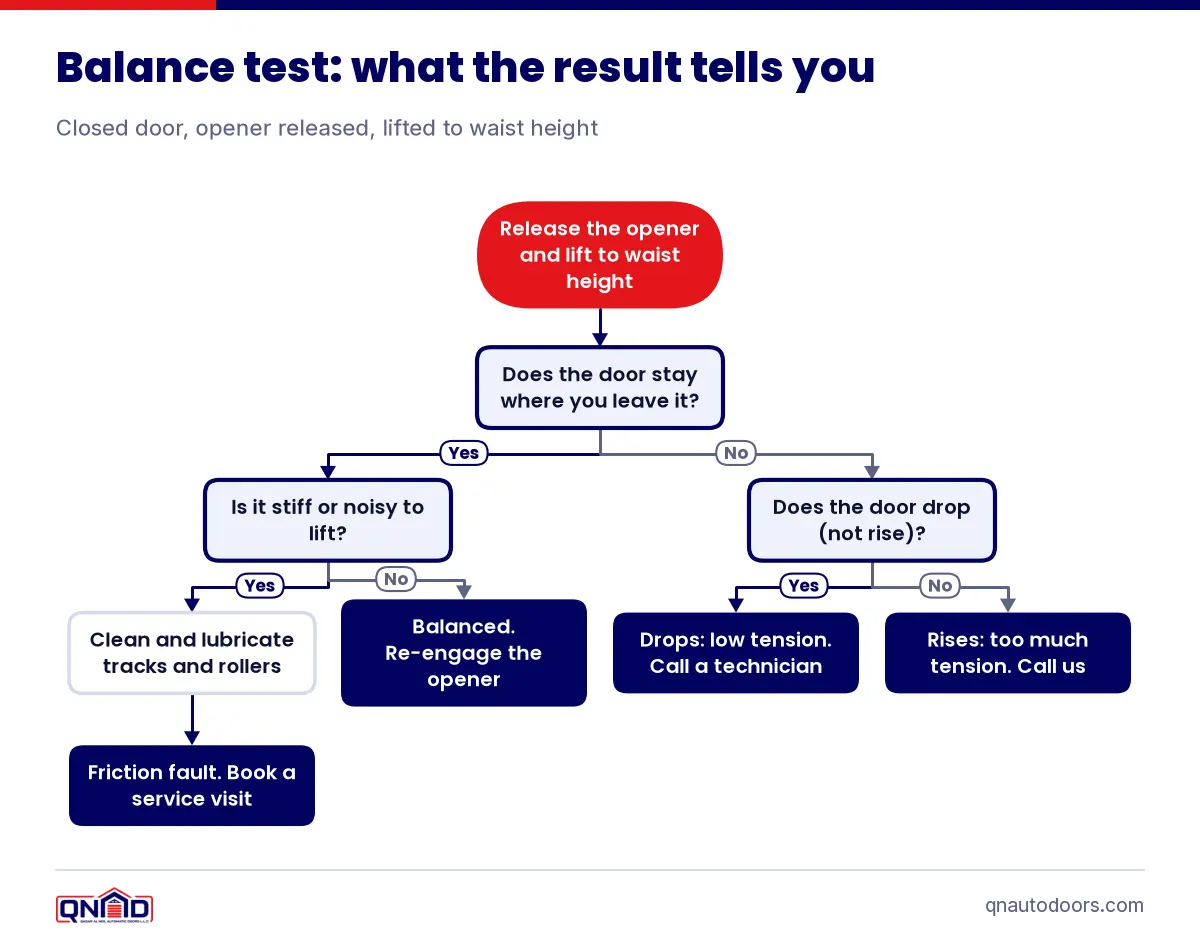
A door that stays near waist height is balanced. A door that drops has too little spring lift. A door that rises on its own has too much. Where it stops, and how fast it moves, tells you the next step.
| What the door does | Likely meaning | What to do |
|---|---|---|
| Stays at waist height and lifts easily | Springs and balance are fine | Re-engage the opener and keep to a routine service |
| Stays, but feels stiff or scrapes | Friction in tracks, rollers or hinges, not balance | Wipe the tracks, look at the rollers, book a service visit |
| Drops slowly | Spring tension has fallen as the springs age | Stop using the opener and call a technician |
| Drops fast or falls shut | A spring may be broken, or tension is far too low | Do not use the door. Call a technician |
| Rises by itself | Too much tension, or a spring was changed to the wrong size | Call a technician to re-set the tension |
| One side higher than the other | A cable has slipped, or the two sides are not equal | Do not use the door. Call a technician |
Springs lose a little strength every time the door cycles. A door that is used several times a day in a busy villa will reach this point sooner than a rarely used one. We do not give a fixed lifespan because it depends on the spring size, the door weight and how often the door runs. Our FAQ on how often garage door springs should be replaced explains what to expect.
Why does a stiff door that stays put still need attention?
Because a door can pass the balance test and still be hard on the opener. If the door stays but scrapes, squeaks or lifts with a drag, friction is taking the energy that should move the door.
In the UAE the usual causes are dust in the tracks, dried lubricant on hinges and rollers, and tracks that have been knocked slightly out of line. Near the Ajman and Sharjah corniches, salt air also corrodes exposed steel faster. A rusty roller does not turn, and a roller that does not turn drags on the track.
Wipe the tracks with a dry cloth, never with water on the motor head. Look at each roller from the floor: it should turn when the door moves. If a roller is worn flat or a hinge looks bent, leave it to a technician. A rolling door in a shop is a different mechanism, so the balance test applies to sectional doors only.
What does heat, dust and sea air do to garage door balance?
They do not change the springs directly, but they speed up the wear around them. Heat dries grease. Dust turns grease into paste. Salt air attacks bare steel on springs, cables and brackets.
A villa in Al Zahia or Al Helio with a double garage and an insulated door has a heavier door than a standard single door. Heavier doors need stronger springs and put more load on them. If someone has added insulation, glazing or a heavy finish to an existing door without changing the springs, the door will drop in the balance test because the springs were chosen for a lighter panel.
Check the springs by eye from the floor each time you do the test. Surface rust is a warning. Fraying on a cable is a stop sign. If the garage faces the sea or is near the Ajman corniche, look more often. The same habit applies to the gate: our guide to gate maintenance in Ajman for heat, dust and sea air covers the pattern.
What can I do myself, and what must a technician do?
You can run the test, wipe the tracks and look. Everything involving spring tension or cables is technician work, because the stored energy can injure a person badly.
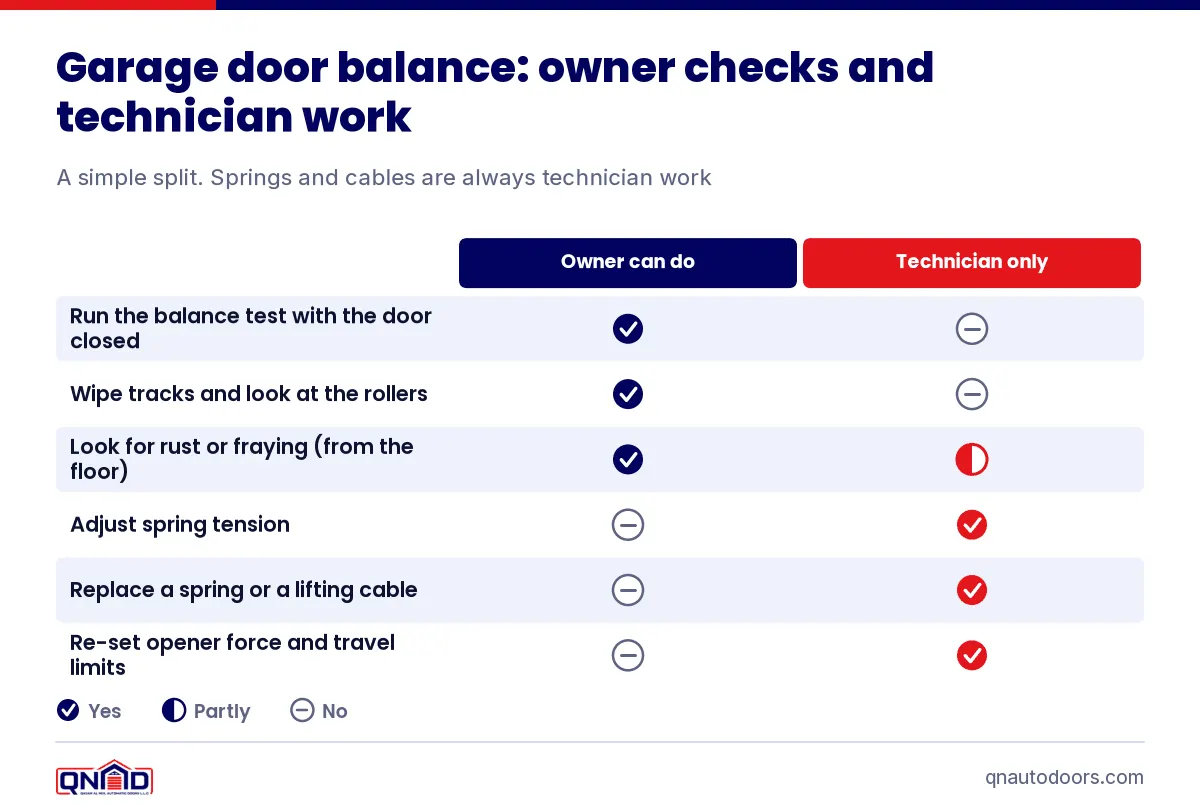
A technician will usually do more than re-tension. They check that the springs are matched, the cables sit on their drums, the rollers turn, the hinges are tight, the bottom seal is sound and the opener's force and travel limits are set again once the door is balanced. Re-setting the opener matters, because a force setting turned up to cover for a bad balance leaves a door that no longer reverses properly on an obstruction.
See our garage door repair in Ajman page for how a visit works, or read the blog on spring replacement signs, risks and what happens on site. If your opener has also stopped working, the garage door motor troubleshooting guide helps you separate the two faults.
Which doors and openers does this apply to?
It applies to sectional doors with torsion or extension springs, the type used on most villas. Our residential garage doors and automatic sectional garage doors are this type. The opener sits on top, and our garage door openers are sized to guide the door, not to lift it.
If your opener is a Marantec, Sommer or Hormann type, the release cord and the carriage work the same way in principle, but the manual for your model shows how to reconnect it. The label on the motor head gives the brand and model, and a photo of it saves time on the first call. See the Marantec page for one of the brands we work with.
What does a service visit for balance look like?
The technician closes the door, looks at the springs, cables and hardware, repeats your balance test and then makes a decision. Sometimes the answer is a simple re-tension. Sometimes a spring pair needs replacing together, and sometimes a worn cable or roller set is the real fault.
Here is a recent villa job in Ajman, described only as the project record states it: a smooth plain white sectional garage door installed on a villa in Ajman.

Smooth Plain Garage Door Installation in Ajman
Ajman. A smooth plain white sectional garage door installed on a villa.
A regular service under a maintenance contract catches balance drift before it becomes a stuck door. Most owners in Ajman and Sharjah only look at the door when it fails, which is when it costs the most to deal with.
What should I send you before the visit?
What to send us
- A photo of the whole door, closed, from inside the garage.
- A photo of the spring and cable area above the door, taken from the floor.
- The result of the balance test: stays, drops slowly, drops fast or rises.
- The opener brand and model from the label on the motor head.
- The door width, and whether it is a single or a double door.
- Whether anything was added to the door, such as insulation, glass or a new finish.
Send these as photos and we can tell you whether it sounds like a tension fault, a friction fault or a broken part before anyone drives to you.
Frequently asked questions
How often should I do the garage door balance test?
Twice a year is a sensible habit, once before the summer and once after it. Do it also if the opener starts to strain, the door closes faster than before, or you hear new noises. It takes three minutes and costs nothing.
Can I do the balance test with the door open?
It is safer closed. With the door open, the full weight sits on the springs and tracks above your head. If you must check an open door, ask a technician. For your own check, always start with the door closed.
My garage door is heavy but it stays when I let go. Is that normal?
A door can stay put and still be heavy because of friction. Dust in the tracks, dry rollers or a bent hinge all make a heavy lift. That is a service job rather than an emergency, but it shortens the life of the opener if you leave it.
Why does my garage door close by itself after I release it?
That is a drop, which means low spring tension or a broken spring. Do not keep using the door with the opener. The motor is being asked to hold the weight the springs should carry, and the door may fall if the opener loses power or the carriage lets go.
Can a garage door be too well balanced?
No, but it can be over-tensioned. A door that rises by itself has too much tension, which wears the cables and can make the door lift when it should be closing. A technician re-sets it. Do not loosen anything yourself.
Is the balance test safe for a double garage door?
Yes, with care. A double door is wider and heavier, so ask a second person to stand clear. If the door feels too heavy to lift to waist height, stop and call a technician instead of forcing it.
Does the balance test apply to a rolling shutter?
No. A rolling shutter winds onto a barrel and uses a different spring arrangement inside the barrel. The test described here is for sectional garage doors. For a shutter that sticks or runs rough, send us a photo and the motor label.
Need a hand? Call +971 50 495 3512, send photos through the photo page, ask for a written quote, or book a site visit. We cover Ajman and Sharjah, and book Dubai and Abu Dhabi jobs by appointment.
Need this done on your property?
Tell us the opening, the fault or the equipment. We reply with a free site visit and a written quote.
Call +971 50 495 3512 WhatsApp us Get a quote
Open 24/7 · Same-day technician · Free site visit
#garage-doors#troubleshooting#maintenance#villas#ajman#sharjah#repair-guide
Related products
-
 Featured
Automatic Sectional Garage Doors
Insulated automatic sectional garage doors for UAE villas and workshops: they lift vertically, need no swing space and run on a quiet operator with safety stops and remote or phone control.
View details -
 Featured
Residential Garage Doors
Garage doors for villas and homes in insulated sectional, roller and side-hinged styles, with finishes to suit the house, quiet operators and remote or phone control.
View details -

Garage Door Openers
Chain, belt and shaft garage door openers for sectional and roller doors, supplied, fitted, replaced and repaired after a free site visit anywhere in the UAE.
View details