


Quick answer
A crash rating records a standard test in which a vehicle of known class hits a barrier at a set speed and angle, and how far it got through. PAS 68 and IWA 14 are the common European and international labels, ASTM F2656 the US one. A rating applies only to the tested model and foundation.
Key takeaways
- A crash rating describes one standard test: vehicle class, speed, angle and penetration.
- PAS 68 and IWA 14 are the usual labels in the UAE; ASTM F2656 is the US equivalent.
- The rating applies to the tested model with its tested foundation, not to any post of that look.
- Ask for the test report, not just the brochure claim.
- Your consultant or authority sets the required rating; we do not claim certificates we do not hold.
Short answer: a crash rating is the written result of a standard test in which a vehicle of a known class hits a barrier at a set speed and angle, and the report records how far the vehicle got through. PAS 68 and IWA 14 are the usual labels in the UAE, ASTM F2656 is the US one. A rating belongs to the tested model with its tested foundation, so ask for the test report.
Door or gate giving you trouble?
Call +971 50 495 3512 WhatsApp us Get a quote
Open 24/7 · Same-day technician · Free site visit
Search for crash rated bollards and you land on vendor pages full of codes. This guide decodes them without selling you one. It is written for building managers, consultants and shop or compound owners who have been handed a datasheet or a specification line and need to know what it means, before they decide what to order.
What does crash rated actually mean?
It means the barrier has been hit in a controlled test, by a defined vehicle at a defined speed and angle, and the result was written down. It does not mean the post can stop any vehicle, and it does not describe how the post looks.
The test records what happened to the barrier and how far the vehicle or its load travelled past the line. Different labels record the same ideas in different formats. A decent datasheet therefore names the standard, the vehicle class, the speed, the angle and the penetration result. If a brochure only says "crash rated", ask which test, which vehicle and which foundation.
For the everyday question of whether you need an impact rating at all, see what is a crash rated bollard and do bollards need to be impact rated. For types and installation in general, read our bollards in the UAE guide.
How do I read a crash rating label?
Break it into five parts: the standard, the vehicle, the speed, the angle and the penetration. Every serious label carries all five, in different order.
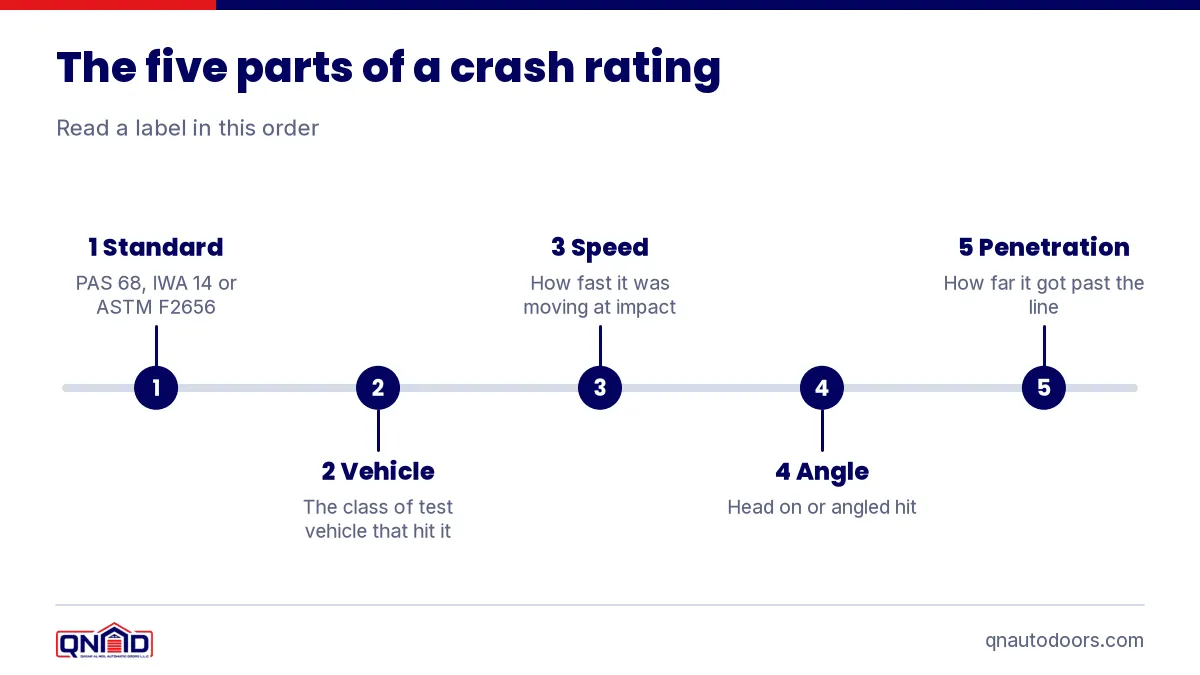
- Standard: which test method was used, such as PAS 68, IWA 14 or ASTM F2656.
- Vehicle: the class that hit the barrier, from a car or pickup up to a heavy goods vehicle.
- Speed: how fast the vehicle was moving at impact.
- Angle: usually a head on hit; some tests use an angled hit.
- Penetration: how far the vehicle or debris got past the barrier line. Smaller is better.
The exact string layouts differ. We do not reproduce them here from memory because they are updated from time to time. Use the current edition of the standard or the manufacturer's own explanation of its label, and ask the supplier to point to each of the five parts.
PAS 68, IWA 14 and ASTM: what is each one?
PAS 68 is a British specification for vehicle security barrier systems. IWA 14 is an international workshop agreement for the same kind of test. ASTM F2656 is the American test method. All describe an impact test and a rating, so they are comparable but not identical.
| Label | Where it comes from | What it tells you |
|---|---|---|
| PAS 68 | British specification | Impact test of a vehicle security barrier, with a rating that names vehicle, speed, angle and penetration |
| PAS 69 | British guidance | Guidance on selecting and installing vehicle barriers, not a test rating |
| IWA 14 | International workshop agreement | Part 1 covers the impact test method and rating, part 2 covers application guidance |
| ASTM F2656 | American test method | Rating by vehicle designation, speed class and penetration class |
| K ratings | Older US labels | Older speed bands that you may still see on old datasheets |
Datasheets in the UAE often cite PAS 68, newer ones IWA 14, and some cite both or ASTM. Check which edition is named, because standards are revised. We are not an approving body and do not claim any certificate. For the formal requirement on a project, ask your consultant and the authority.
Which test vehicle classes do the labels use?
They range from a small car through a pickup or van to a medium truck and a heavy goods vehicle. The class tells you what weight the barrier was proven against.
| Test vehicle class | What it represents | Where it matters |
|---|---|---|
| Passenger car | A car at moderate speed | Low risk frontages and car parks |
| Pickup or van | A common light commercial vehicle | Public entrances, malls, schools |
| Medium truck | A rigid truck | Higher risk buildings and event sites |
| Heavy goods vehicle | A loaded heavy lorry | The most demanding sites, set by a consultant |
Which class a building needs is a security and engineering decision made by a consultant or an authority. A shop owner who just wants to stop a parked car going through the glass does not need the heavy class, and our note on bollard types and uses explains the usual choices.
Why does the foundation matter as much as the bollard?
Because the test was done with one bollard on one foundation. Change the depth, the soil, the slab or the number of posts, and the result no longer applies.
A crash rated bollard normally needs a deep, reinforced foundation, and that is where UAE sites run into trouble: shallow slabs, cable trays, drainage and services under the pavement. Ask for the foundation drawing with the datasheet and check it against what is below your site before you order. Our answer on government and high security buildings covers the same point from the buyer side.
What documents should I ask a supplier for?
Ask for these in writing
- The standard named and its edition.
- The vehicle class, speed and angle used in the test.
- The penetration result, in the units the standard uses.
- The exact model and size tested, with its foundation drawing.
- The test report from the test body, not just a brochure line.
- The installation method and any limits on soil, slab or services.
If a document is missing, ask for it. If the supplier cannot provide it, treat the claim as unproven. QNAD supplies and installs bollards, and where a project calls for a crash rating we pass your requirement to the manufacturer and ask for the test report. We will not promise a rating that the datasheet does not show.
Does a crash rating apply to gates and barriers too?
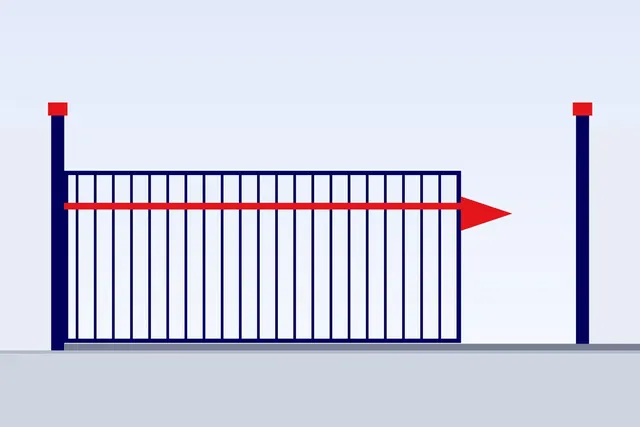
Yes. The same test methods are used for sliding gates, barriers and wedges. A rated gate or barrier is a different product from a standard one, and the same questions apply: which standard, which vehicle, which foundation.
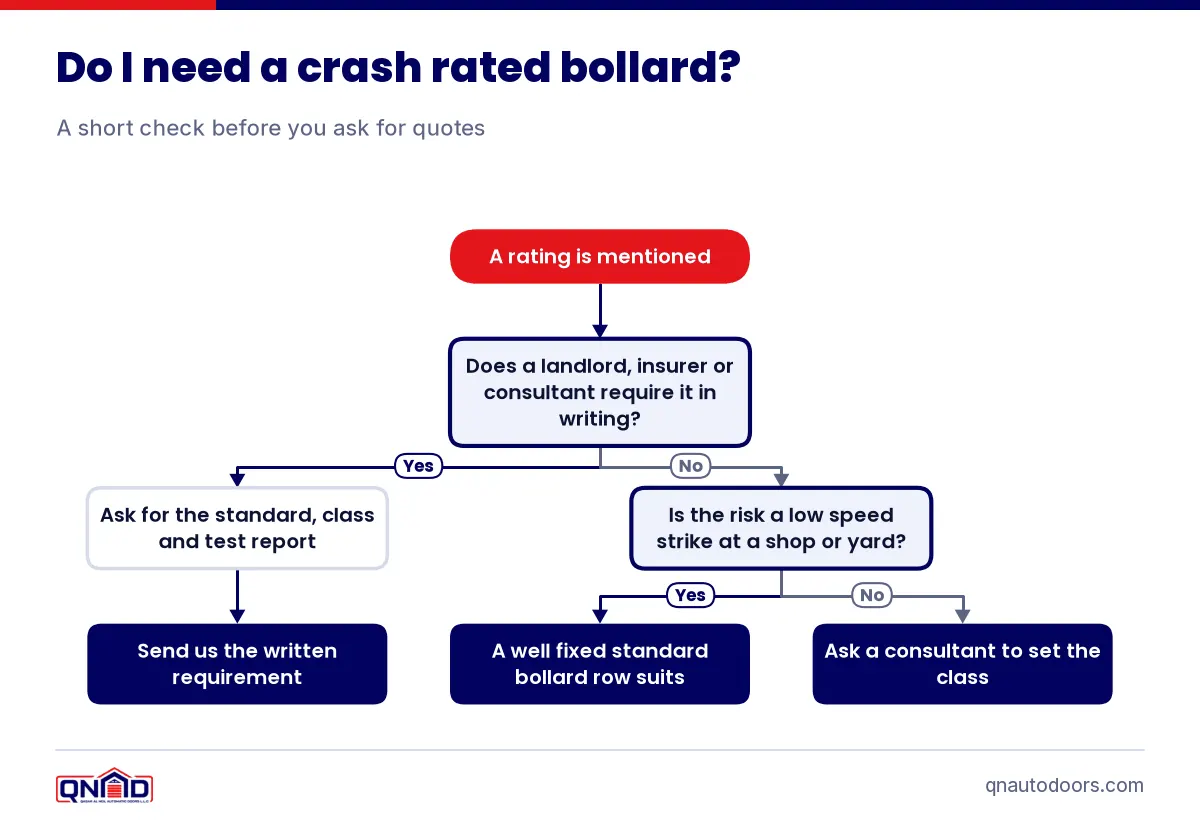
For an ordinary compound or yard, a normal sliding barrier or automatic sliding gate is chosen for traffic control and security, not for crash resistance. If a landlord asks for a rated unit, ask for the requirement in writing and send it to us with your photos.
Where do crash ratings come up in the UAE?
On government buildings, airports, hotels and malls, event spaces, banks and critical infrastructure. In the northern emirates they can come up in Sharjah projects and around waterfront sites such as Ajman Corniche, where a consultant may set a requirement for a hotel or tower.
Most small shops and compounds do not need one. They need a well fixed standard bollard row. Salt air near the coast and heat on the paintwork also matter for any bollard, rated or not, so ask about the finish.
How does QNAD help with crash rated bollard enquiries?
Qasar Al Neil Automatic Doors (QNAD) is based in Ajman and serves Ajman and Sharjah, with Dubai and Abu Dhabi by appointment. Send us the specification line and your photos. We read the requirement with you, tell you honestly whether a standard or a rated product is being asked for, and ask the manufacturer for the documents. We visit the site for free to check the ground and services. See the glossary for other terms, and our bollards service page.
Frequently asked questions
Is PAS 68 the same as IWA 14?
They are related but not identical. Both describe a vehicle impact test and a rating. IWA 14 is the international version. Check which one a datasheet cites and which edition, and ask your consultant which the project accepts. If the datasheet cites only one, ask the supplier whether a report under the other exists.
Can I tell a crash rated bollard by looking at it?
No. A rated and an unrated bollard can look similar. The rating lives in the test report and the foundation design, so ask for those documents and the exact model tested. A photo or a sample on a showroom floor proves nothing about how it behaves in a crash.
Does a crash rated bollard need a deep foundation?
Normally yes. The rating applies only with the foundation that was tested. On many UAE sites cables, drainage and shallow slabs are the real obstacle, so check the ground before you order. Ask the supplier for the foundation drawing and the depth it assumes, then compare it with your site.
Do I need a crash rated bollard for a small shop?
Usually not. A well fixed standard bollard row suits everyday low speed strikes. If a landlord, insurer or consultant asks for a rating, get the requirement in writing and send it to us. We are happy to say so plainly on a free site visit if a standard bollard is enough.
What is penetration in a crash rating?
It is how far the vehicle or its debris moved past the barrier line after the test. A smaller figure means the barrier held the vehicle closer to the line. Each standard has its own penetration classes. Ask which penetration class the datasheet claims and check it against the test report.
Can QNAD supply a PAS 68 or IWA 14 rated bollard?
Send us the requirement. We ask the manufacturer whether a tested product exists and request the documents. We do not claim a certificate for any product and we say clearly what the datasheet does and does not show. Please send the specification line so we can ask the right question first.
Holding a bollard specification and not sure what it means? Send it to us.
Call us on +971 50 495 3512, or send details through the quote form. If you would rather show us than describe it, send a photo or book a free site visit. We cover Ajman and Sharjah, and book Dubai and Abu Dhabi jobs by appointment.
Need this done on your property?
Tell us the opening, the fault or the equipment. We reply with a free site visit and a written quote.
Call +971 50 495 3512 WhatsApp us Get a quote
Open 24/7 · Same-day technician · Free site visit
Related products
-
Automatic Sliding Gates
Made-to-measure automatic sliding gates for villas, compounds and industrial yards, with a quiet motor, photocells and remote, keypad, intercom or phone control.
View details -

Gate Barrier
A low sliding barrier for vehicle entrances where a boom arm will not fit, working with loop detectors, photocells, tags, keypads and number-plate recognition.
View details -

Bollards
Fixed, removable and automatic bollards in steel, stainless steel or concrete-filled forms, with groundwork, loops, lighting and servicing for sites across the UAE.
View details