


Quick answer
If a gate motor stops after heavy rain or a wash down, do not reset it repeatedly. Keep clear of wet equipment, check whether the breaker trips or anything smells burnt, and let it dry. If it works after drying it was a wet fault, so seal the cable entries. If it trips again, stop and call a technician.
Key takeaways
- Do not reset a wet gate repeatedly, and never open the control box in the wet.
- A tripping breaker, a burnt smell or water inside the box or pit means stop.
- A gate that works again after drying had a wet fault, so find where the water got in.
- Mud and silt in the track stop gates after rain even when the motor is fine.
- Never pressure wash the motor, the control box or the photocells.
- Seal cable entries and keep drains clear before the next storm.
Short answer: If a gate motor stops after heavy rain or a wash down, do not keep resetting it. Keep clear of wet equipment, check whether the breaker trips or anything smells burnt, and let it dry. If it works again after drying, it was a wet fault, so find where the water got in and seal it. If the breaker trips again, stop and call a technician.
Door or gate giving you trouble?
Call +971 50 495 3512 WhatsApp us Get a quote
Open 24/7 · Same-day technician · Free site visit
Why does a gate stop after rain or a wash down?
Because water has reached something that does not like it: the control board, a terminal, a cable entry, a limit switch, a photocell lens or the track. Rain in the UAE is not frequent, but when it comes it is heavy, and the gates that were built for dry months meet it all at once. A hose or pressure washer does the same, only from below and at close range.
Most of these faults are small and some fix themselves once things dry. Others are not safe to touch. This page helps you sort one from the other. It sits beside our general guide to rainy season care for gates, garage doors and shutters, and goes deeper on the fault itself.
What should I do first, and what must I never do?
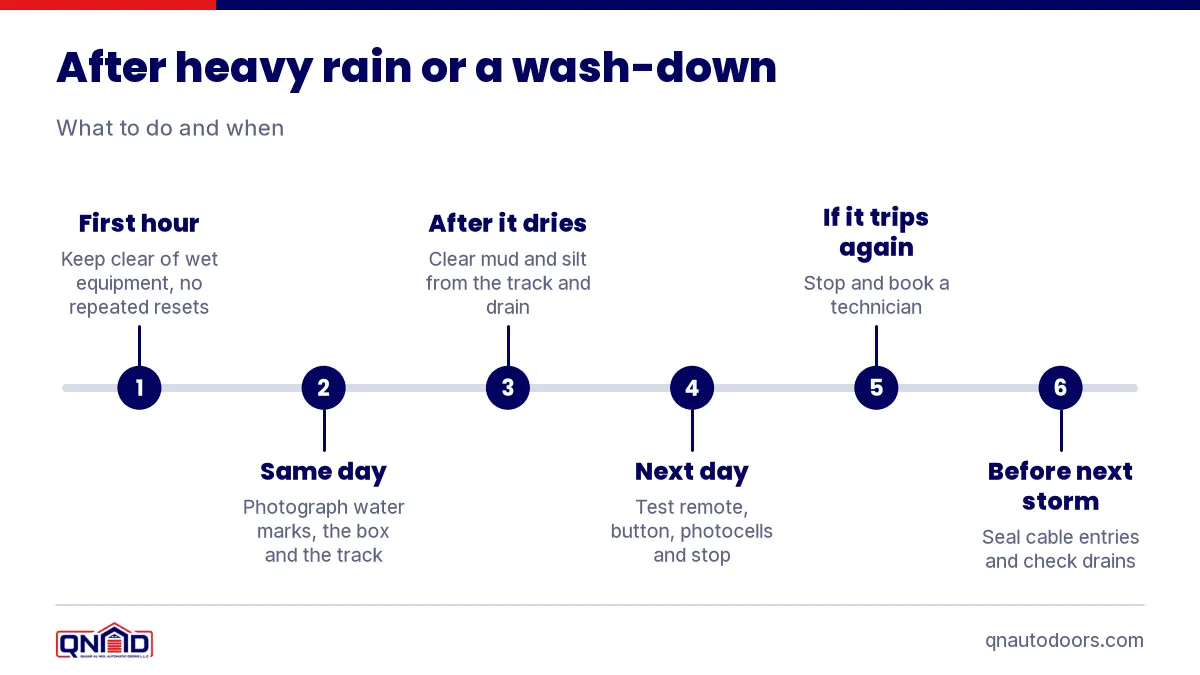
Keep clear of wet equipment and do not reset repeatedly. Water and mains voltage are a bad mix, and every reset into a wet board can add damage.
- Do: stay dry, keep children and pets away, note whether the breaker or residual current device tripped, and photograph water marks.
- Do: use the key release only if you can do it without touching wet electrical parts, and put the gate in a safe position.
- Do not: open the control box in the wet, press reset again and again, or spray anything into the box.
- Do not: use a heater, a hair dryer or compressed air on the electronics.
- Do not: pressure wash the motor, the control box or the photocells, ever.
Our safe first steps for a stuck gate sets out the rest of the safe routine.
How do I tell a wet fault from a dry one?
A wet fault follows the water and often improves as things dry. A dry fault has another cause and stays. The flow below sorts the common cases in four questions.
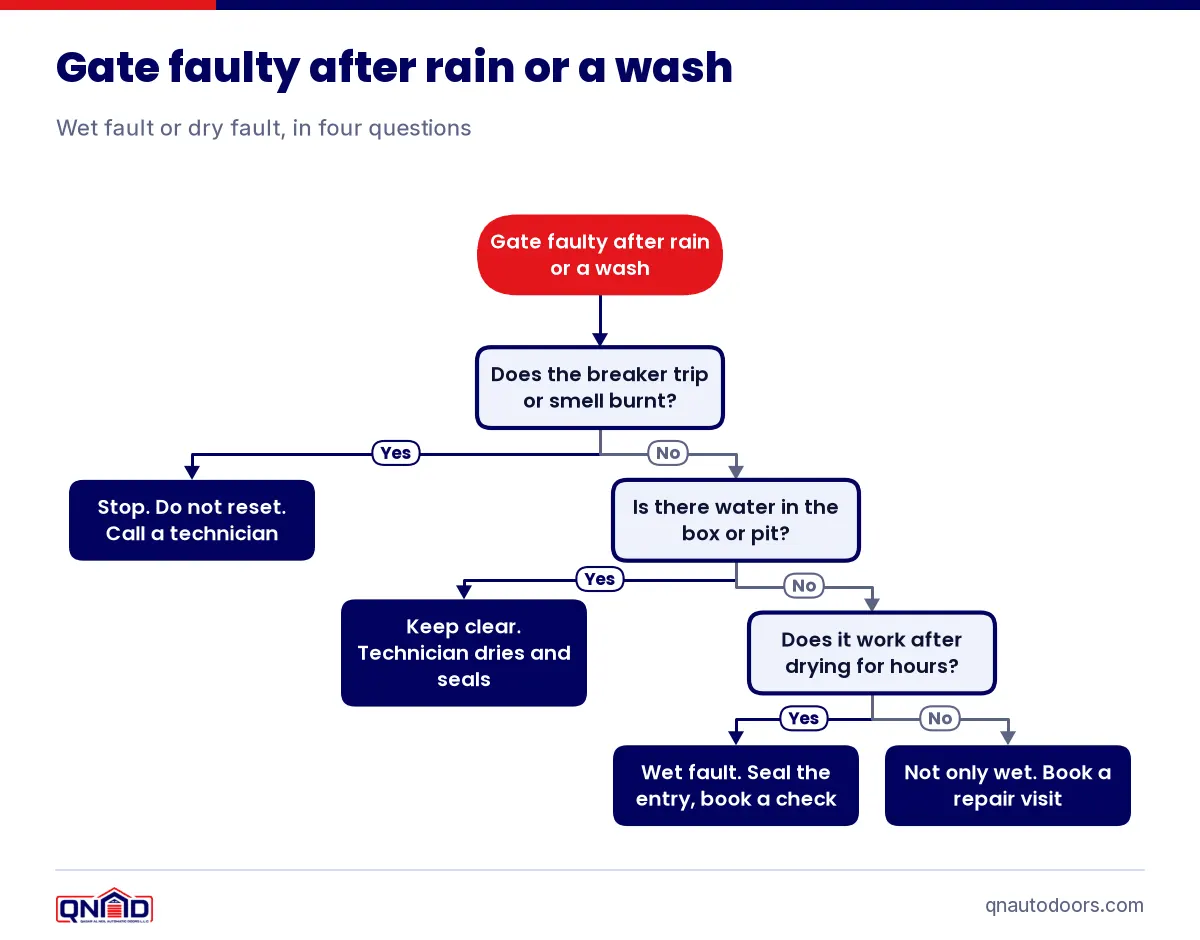
Clues point the same way. A wet fault often comes and goes through the day, worsens after the next shower, and shows condensation under the lid or a green or white crust on terminals. A dry fault that happened to coincide with the storm stays the same when it is dry. It often follows a power cut or a surge, not the water itself. Our guide to gates and doors in a power cut covers that case.
Which symptoms point to which wet fault?
Symptoms after rain or a wash, with likely causes
| What you see | Likely wet cause | What is safe for you to do | When to stop |
|---|---|---|---|
| Gate dead, no lights | Water in the control box, or the breaker tripped | Check the breaker status only | If it trips again or smells burnt |
| Breaker or residual current device trips | Water on live parts, or a damp cable joint | Leave it off | At once. Call a technician |
| Gate opens but will not close | Photocell lens fogged, or beams knocked by water or mud | Wipe lenses gently with a soft cloth | If it still stops |
| Remote range drops sharply | Damp receiver or antenna | Try close to the gate | If it does not return after drying |
| Gate slow, stops midway or jams | Mud, silt or standing water in the track | Clear loose debris from the track by hand when dry | If the gate has bent or left the track |
| Gate moves but beeps or flashes an error | Damp limit sensor or wiring | Note the lamp pattern | If it repeats after drying |
| Water in the pit of an underground motor or a bollard | Drain blocked or pit flooded | Keep clear and photograph | Always. A technician pumps and checks |
Our FAQ on resetting a swing gate motor after a fault explains when a reset is reasonable. After rain, it is reasonable only once things are dry and the breaker has not tripped.

Why do pits, tracks and entries matter most?
Because water collects there. Anything set into the ground, such as the housing of an underground swing motor or the pit of an automatic bollard, needs a drain that works. A blocked drain turns a rain shower into a flooded pit. The track of a sliding gate collects sand, and sand plus water makes silt that grips the rollers. And a cable entry with no gland lets water run down the cable and into the box.
For automatic sliding gates, clear the track after rain and look at the drain. For automatic swing gates, look at the hinge and the motor housing. For both, the motor should sit above the water line and its box should be closed and sealed.
What does an IP rating tell me?
An IP rating is a two digit code. The first digit is about dust and solids, the second about water. A higher second digit means more protection against water, for example splashes or jets, but it is not a promise about every use. Ask the manufacturer what the motor, control box and photocells are rated for, and confirm it suits where they are fitted and how you clean them.
A rated box can still fail if a cable entry is open, a lid is not closed or a seal has aged in the sun. In practice, the rating and the installation both matter.
Where is this most likely in Ajman and Sharjah?
Low driveways and gates at the bottom of a slope take the water. In coastal areas such as Al Khan and parts of Ajman near the corniche, humid air and spray add to the problem, and our FAQ on salt air near Al Khan and Al Majaz explains the longer term effect. In Al Nuaimiya and other older areas, villa gates often have old cable entries. In industrial yards in the Ajman Industrial Area and Sajaa, trucks washed beside the gate and drains full of silt cause a different set of faults.
How do I stop it happening again?
- Keep drains and the track clear before the rainy months and after each storm.
- Close and seal cable entries with proper glands, and check the lid gasket.
- Raise or shade boxes where possible, so they sit above splash and away from direct sun.
- Wash with a bucket and cloth, not a jet, near any electrical part.
- Ask a technician for a check before the rains if the gate is older.
For regular checks, our maintenance contract page explains how visits work, and the guide on protecting controllers and batteries from summer heat covers the other half of the year. Control boards that have corroded can be replaced, and we explain the options for control panels and photocells and safety sensors.
What does a technician do after water damage?
The technician isolates the power, opens the box and looks for water, corrosion and burn marks. Wet terminals are cleaned and dried, corroded ones replaced, and a damaged board is replaced if it cannot be saved. Cable entries are resealed, drains cleared, and the photocells, safety stop and limits are tested. Then the gate is run through full cycles. Here is a service visit as the project record describes it: a gate barrier in Sajja, Sharjah, received a maintenance visit to keep vehicle access smooth, controlled and secure, because regular service finds faults early.
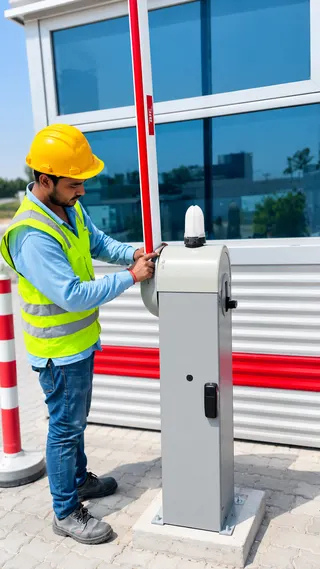
Gate Barrier Service Visit in Sajja, Sharjah
Sajja, Sharjah. A gate barrier received a maintenance visit to keep vehicle access smooth, controlled and secure, because regular service finds faults early.
For Sharjah jobs you can book through our gate repair in Sharjah page.
What should I send so we can tell wet from dry?
What to send us
- A photo of the gate, the motor and the area around it, showing standing water or silt.
- A photo of the control box from outside with the lid closed, and of the cable entries.
- Whether the breaker or residual current device tripped, and when.
- The lamp or beep pattern, as a short video.
- Whether anything else was wet: the remote, the photocells, the pit or the track.
- Whether there was also a power cut or a surge on the same day.
Frequently asked questions
Can a gate motor dry out and work again by itself?
Sometimes. If water only reached the outside of the box or a terminal, the gate can recover after drying. But corrosion may already have started, so a technician should check it. If the breaker tripped, do not switch it on again.
Why does my gate work in the morning and fail after rain?
That pattern points to moisture. Condensation or a damp joint can make a connection fail only when it is wet and recover when it dries. Photograph the box and cable entries and ask for a check before the next storm.
Is it safe to open the control box after rain?
No, not by an owner. The box holds mains voltage and damp surfaces. Leave the box closed and keep clear. A technician isolates the power first, then dries, cleans and tests the parts inside, and replaces any that have corroded.
Can I wash my gate with a hose or pressure washer?
Wash the leaf with a bucket and cloth, and keep jets away from the motor, the control box, the photocells and the cable entries. A pressure washer can push water past seals that survive rain, and it often causes the fault it was meant to prevent.
Why does my gate stop halfway after rain?
Often because mud or silt has built up in the track, or the safety beam is blocked or fogged. Clear loose debris by hand when dry and wipe the lenses. If it still stops, the limit sensor or the board may be damp and needs a technician.
Does water damage my underground gate motor or bollard?
It can if the pit does not drain. Anything below ground relies on a drain that stays clear. If you see water in the pit after rain, keep clear and photograph it. A technician can pump the pit, dry the parts and check the drain.
Gate stopped after the rain? Call +971 50 495 3512, send photos through the photo page, ask for a written quote, or book a site visit. We cover Ajman and Sharjah, and book Dubai and Abu Dhabi jobs by appointment.
Need this done on your property?
Tell us the opening, the fault or the equipment. We reply with a free site visit and a written quote.
Call +971 50 495 3512 WhatsApp us Get a quote
Open 24/7 · Same-day technician · Free site visit
#troubleshooting#maintenance#sliding-gates#swing-gates#ajman#gate-safety#sharjah#gate-motors
Related products
-
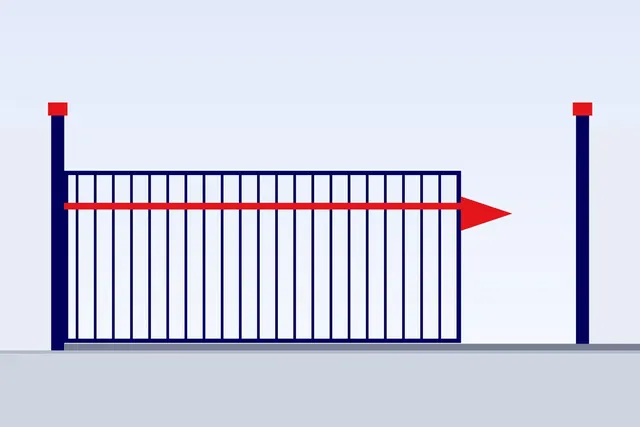
Automatic Sliding Gates
Made-to-measure automatic sliding gates for villas, compounds and industrial yards, with a quiet motor, photocells and remote, keypad, intercom or phone control.
View details -
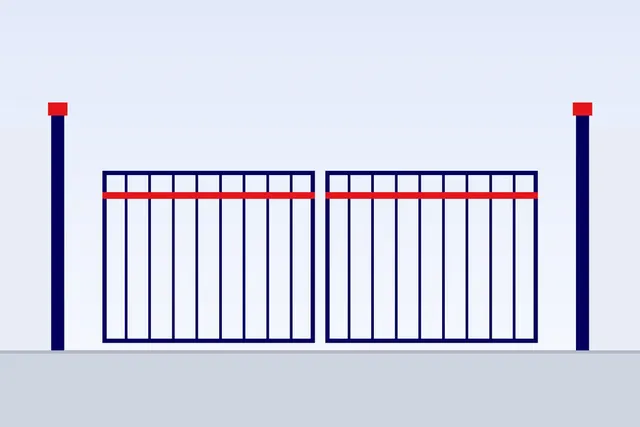
Automatic Swing Gates
Automatic swing gates for villas, farms and compounds, using arm, ram or underground operators with safety devices, and able to automate an existing manual gate.
View details -

Bollards
Fixed, removable and automatic bollards in steel, stainless steel or concrete-filled forms, with groundwork, loops, lighting and servicing for sites across the UAE.
View details -

Gate Motors
Sliding, swing, underground and ram gate motors sized to your gate, supplied, fitted, replaced and repaired after a free site visit anywhere in the UAE.
View details