


/
ANPR reads a number plate with a camera, checks it against an allowed list and signals the barrier to open. Results depend on lane layout, light, dust, stopping position and a fallback for unread plates. Barrier safety loops and photocells remain separate. Decide data retention and access before go-live, and confirm rules with your legal adviser.
- ANPR is a chain of trigger, camera, light, recognition, list check and barrier, and the weakest link sets the result.
- In the UAE, low sun, dust on the lens window, dirty plates and the stopping point cause most read failures.
- Specify a fallback for unread plates before choosing cameras.
- The barrier still needs its own loops and photocells; the camera is not a safety device.
- Settle who owns the plate list, how long logs are kept and who can search them, and confirm the rules locally.
هذا المحتوى متاح حالياً باللغة الإنجليزية فقط. English
Short answer: An ANPR system uses a camera to read a number plate, checks it against a list you control, and tells the barrier to lift or stay down. It works or fails on the lane, not the software: camera angle, light, dust, stopping distance and what happens when a plate cannot be read. Specify the lane, the fallback and the data rules before you compare cameras.
Key takeaways
- ANPR is a chain: trigger, camera, light, recognition, list check, barrier. The weakest link sets the result.
- In the UAE the usual enemies are low sun at the lens, dust on the housing, dirty or bent plates and a car parked on the trigger.
- Always specify a fallback for unread plates: intercom, guard override, remote or card.
- The barrier needs its own safety devices. The camera never replaces a loop or photocell.
- Plate images and logs are personal data in practice. Decide retention and access before go-live, and confirm the rules with your legal adviser or community management.
How does an ANPR parking system work?
People describe ANPR as "the camera opens the gate". That skips four steps where things go wrong. Here is the sequence at a single entry lane.
- A vehicle arrives and is detected, usually by an in-ground loop, or by the camera itself watching for motion.
- The camera takes one or more frames of the plate, helped by an infrared or white illuminator at night.
- Recognition software turns the plate image into text: emirate, code and number, in Arabic and English characters.
- The system looks the plate up. It may be a resident list, an employee list, a visitor pass, a tenant of a rented bay or a blocked list.
- If the plate is allowed, a relay or network command goes to the barrier controller and the arm lifts.
- A loop or photocell holds the arm up while the vehicle passes, then lets it close.
- The event is logged: plate, time, lane, image and decision.
At exit the same chain runs again. Where fees are charged, the system matches entry to exit and calculates the time on site. Fee collection is a separate payment layer, and you should price it separately.
What is inside an ANPR parking system?
When two quotes differ, the difference is usually in this list. Ask for every line to be named.
| Part | What it does | What to ask |
|---|---|---|
| Camera and lens | Captures the plate at the right angle and speed | Mounting height, angle and distance to the stop line |
| Illumination | Gives a readable plate at night and against glare | Is it built in or separate, and how does it cope with headlights? |
| Vehicle trigger | Tells the system a car is present | Loop, camera motion or both |
| Recognition software | Reads characters, including the emirate and code | Does it read your plate types, including Arabic characters and older plates? |
| Database or list | Holds allowed, visitor and blocked plates | Who edits it and how fast does a change apply? |
| Barrier or gate | Physically stops and releases the vehicle | Arm type, speed, safety devices, manual release |
| Fallback point | Handles unread or unknown plates | Intercom, call button, card reader, guard |
| Network and power | Links lanes to the server | Cabling route, power backup, what happens offline |
We supply and install the ANPR parking systems side with barriers and payment integration, and we repair camera, recognition and barrier faults. A wider system sits under parking management systems.
Why does the lane decide whether ANPR works in the UAE?
A recognition engine can be good and still fail on a badly planned lane. Most ANPR complaints we hear describe a lane problem that arrived dressed as a software problem.
Light. A low morning or evening sun pointing straight into the lens washes out the plate. Facing the camera away from the sun path, or shading it, matters more than the camera model. At night, a bright reflective plate and a powerful headlight can blind a poorly placed lens.
Heat. Afternoons of 45 to 50 C turn an unshaded camera housing into an oven. Electronics age faster, condensation forms when the housing cools at night, and plastic brackets sag. Ask where the processing unit lives and how it is kept cool.
Dust and salt. On the Ajman and Sharjah coast, salt mist and fine dust settle on the window of the housing. A film does not stop the camera outright. It lowers the read rate slowly, and nobody notices until residents complain about the gate hesitating.
Plates. Dirty, bent, tinted or covered plates, towed trailers, motorbikes and plates fixed off-centre all read worse. A system that is perfect in the demonstration meets these every day.
Field note: The first thing we check on a hesitating ANPR lane is not the settings. It is the lens window, the sun angle and where cars actually stop. Drivers stop at the barrier, not at the stop line you drew, and the camera may be looking at the wrong spot.
Which sites suit ANPR best: villas, offices, malls or industrial units?
The same camera does different work on each site. Decide which one you are before you ask for a quote.
| Site | What you want from ANPR | Watch out for |
|---|---|---|
| Villa compound or tower in Ajman or Sharjah | Residents in without a tag, visitors by pre-registration | Many tenants, plate changes when cars are replaced, visitors who do not know the plate |
| Office building or business park | Staff list, visitor passes, evidence of who entered | Fleet and pool cars, contractors with temporary vehicles |
| Mall or retail car park | Counting vehicles, ticketless entry and exit | Queue length, peak weekends, stacking space before the barrier |
| Industrial unit in Al Jurf Industrial Area or Sharjah Industrial Areas | Trucks and approved suppliers logged in and out | Dust, long vehicles, trailers, reflective or missing plates |
| Free zone or gated estate such as Ajman Free Zone or Muwaileh | Tenant lists across many companies | Different list owners and who approves each list |
If the site is a villa gate with a handful of cars, ANPR is often more than you need. A remote, tag or card is simpler. Our note on biometric, RFID and face recognition access compares the options for offices.
What should you specify before asking for an ANPR quote?
Quote differences nearly always come from things left unwritten. Send us this list, or fill it in at a site visit.
- How many lanes, entry and exit, and the width of each lane.
- Space before the barrier: how many vehicles queue without blocking the road?
- Who must be allowed: residents, staff, visitors, contractors, deliveries, trucks.
- How visitors are added: by the resident, by security, or by a phone pass.
- What happens when the plate is unread: intercom, guard or remote release.
- Whether you need fee calculation or only access.
- Where the cabling can run and where power and network are available.
- Who owns the list and who can read the logs.
- Whether the existing barrier is kept or replaced.
Photographs help. Send us: the entrance from the street, the stop line, the wall or pole where a camera would go, the existing barrier, the power point and the guard cabin.
Same-scope quote comparison worksheet
| Line | Quote A | Quote B | Quote C |
|---|---|---|---|
| Number of lanes covered | |||
| Camera count and illuminator type | |||
| Loops and photocells included | |||
| Barrier or gate included, arm length and speed | |||
| Fallback for unread plates | |||
| Software licence terms, one-time or yearly | |||
| Data storage location and retention setting | |||
| Training and handover | |||
| Maintenance visits and what they cover |
A blank cell is a question. A quote that lists the barrier but not the loop, or the camera but not the fallback, is cheaper because it is shorter.
How does ANPR connect to barriers, loops and gate safety?
The camera sends an "open" command. Everything else keeps people and vehicles safe, and none of it is the camera's job.
- Safety loop: an in-ground loop under the arm holds it up while a car is beneath. Read how loop detectors work with parking barriers, and see our loop detector service.
- Photocells: add a second layer where pedestrians cross. We cover them in the post on gate safety devices.
- Arm type: a boom arm needs headroom, a low canopy needs a sliding barrier, and pedestrians need a swing barrier or a turnstile. See boom, sliding and swing barriers compared, or look at the sliding barrier, swing gate barriers and turnstile gates.
- Bollards: where a barrier is not enough, automatic bollards can take the same open command. Ask about it in this FAQ on ANPR and bollards.
- Power cuts: UAE summer storms and grid dips happen. Decide in advance whether the lane fails open, fails closed, or runs on a battery, and where the manual release is. See barriers during power failure.
- Fire and emergency exit: if the lane is also an emergency route, ask your consultant and the approving authority what the barrier must do on an alarm. We do not state a rule here.
Field note: A camera that gives a perfect read every time is still a risk if the barrier arm drops on a bumper. We fit the safety device first and the recognition second. If someone offers you ANPR without a loop or photocell on the barrier, ask why.
Is ANPR a privacy risk? How data is handled
A plate image tied to a time and a place is information about a person, even though it only shows a car. We are installers, not lawyers, so treat this as a list of questions rather than legal advice.
- Who is the owner of the list and the logs: the developer, the owners association, the facilities company or the tenant?
- How long are images and logs kept, and is the setting written into the handover?
- Who can search and export them, and is that access recorded?
- Is there a sign at the entrance saying that plates are recorded?
- Where is the data stored: on a local server in the building, or in an external service?
- What is the process if a resident asks to be removed or to see their records?
The UAE has rules on personal data and community managers often have their own policies. Confirm what applies to your property with your legal adviser, your community management or the master developer before you switch the system on. For us, the practical points are simple: keep the list short, keep retention short, and limit who can search.
Worked example: one entry lane, from stop line to barrier
This is an illustration, not a QNAD job. A tower car park has one entry lane, 3.2 m wide, with a 3 m barrier arm. The stop line is 2.5 m before the arm. A 5 m car at the stop line leaves room for the camera to see the plate from about 4 to 6 m away at a shallow angle. If the lane has stacking space for three cars, about 15 m, the queue stays off the street at the evening peak.
Facing west, the camera would look into the low sun for part of the afternoon. The fix is to shade the housing and angle it down, not to buy a better camera. If a read takes about one second and the arm needs about 3 seconds to lift, a driver who rolls in without stopping may reach the arm before it is up. Slow the approach with a speed bump or a stop sign, rather than expecting the system to hurry the barrier.
What goes wrong with ANPR, and what to do
| Symptom | Likely cause | Action |
|---|---|---|
| Reads fail in the late afternoon | Low sun into the lens or glare on the window | Shade the lens, check the angle, clean the housing window |
| Reads drop slowly over weeks | Dust or salt film on the lens window | Clean it. Add it to the maintenance visit |
| Barrier opens late | Car stops past the read zone, or the trigger is set too far | Move the stop line or adjust the trigger |
| A known plate is refused | List typo, new plate not added, or a similar-looking character misread | Check the list entry, then the stored image |
| All reads fail at once | Power, network or server fault | Use the fallback lane, then call a technician |
| Arm lowers on a car | Loop or photocell fault | Stop and call. Do not use the lane until it is checked |
Mistakes and myths about ANPR parking
| Myth or mistake | What is true |
|---|---|
| "ANPR reads every plate perfectly." | No system does. Plan the fallback. |
| "A better camera fixes a bad lane." | Geometry and light usually decide the result. |
| "The camera is the safety device." | Safety belongs to loops, photocells and the barrier controller. |
| "It needs no maintenance." | Lenses, housings, loops and arms still need regular checks. See our maintenance contract. |
| "Visitors are not a problem." | Visitors are the daily workload. Decide the process first. |
For a past barrier job, see gate barrier maintenance in Sajja, Sharjah.
ANPR terms in English and Arabic
| English term | Arabic term | Meaning |
|---|---|---|
| ANPR | نظام قراءة لوحات المركبات تلقائيا | Reads plates by camera to open a barrier |
| Number plate | لوحة المركبة | The registration plate |
| Barrier | حاجز المواقف | Arm that blocks a lane |
| Loop detector | كاشف حلقي | In-ground coil that senses vehicles |
| Parking management | إدارة المواقف | Lanes, lists and fees managed together |
| Access control | التحكم في الدخول | Deciding who may enter |
| Allowed list | قائمة السماح | Plates that may enter |
| Blocked list | قائمة المنع | Plates that must not enter |
| Maintenance contract | عقد صيانة | Scheduled visits to keep it working |
Frequently asked questions
How accurate is ANPR in the UAE?
Accuracy depends on the lane, the light and the condition of the plates more than the brand. We do not quote a percentage, because it would be invented. At the site visit we check sun angle, stopping position and plate types, and agree a fallback for reads that fail.
Does ANPR work on every UAE plate type?
Good systems are set up for local plates, including different emirates and codes, but older, damaged or unusual plates can read less well. Ask the supplier to demonstrate on your own vehicles, and keep a fallback for the exceptions.
Can ANPR open a villa gate?
It can, but for one family it is rarely worth it. A remote or tag is simpler and cheaper to keep running. ANPR makes more sense on shared entrances with many residents and visitors.
What happens if the camera cannot read my plate?
The lane should send the driver to a fallback: an intercom to security, a call button, a card reader or a guard override. If a system has no fallback, a dirty plate becomes a queue on the road.
Do you install ANPR in Ajman and Sharjah?
Yes. See our answer on ANPR installation. We cover Ajman and Sharjah, and book Dubai and Abu Dhabi jobs by appointment.
Who can see the plate records?
That is for the property owner or facility manager to decide and document. Limit access to named people, record who exports data, and confirm the rules with your legal adviser or community management.
Can I add ANPR to my existing barrier?
Often yes, if the barrier controller accepts an external open signal and its safety devices work. We check the controller, loops and photocells at a survey before we recommend anything.
How often does an ANPR lane need service?
Lens windows, loops, barrier arms and the fallback intercom need regular checks. Dust and salt make it more than a yearly job on exposed lanes. The frequency is agreed per site in a maintenance plan.
Is ANPR cheaper than cards?
Not at the start. Cameras, lighting, software and integration usually cost more than readers. The savings come from no lost cards and less guard time, and the figure depends on your site. A site visit gives a quote for your scope.
Next step
If you are planning an ANPR lane, send a photo of the entrance with send a photo, or book a site visit and we will check the lane geometry, the barrier and the fallback. You can also request a quote or call +971 50 495 3512. We cover Ajman and Sharjah, and book Dubai and Abu Dhabi jobs by appointment.
منتجات ذات صلة
-
حواجز البوابات المتأرجحة
حواجز متأرجحة للمشاة آلية للردهات ومناطق الاستقبال تفتح للأشخاص المصرح لهم وتغلق خلفهم، مع وصلات قارئ البطاقة أو الوجه أو بصمات الأصابع.
عرض التفاصيل -
البوابات الدوارة
حامل ثلاثي الأرجل، وبوابات دوارة كاملة الارتفاع وحارة السرعة تسمح بدخول شخص واحد في كل مرة، مع روابط قارئ البطاقات والوجه وبصمات الأصابع للمكاتب والملاعب والمواقع.
عرض التفاصيل -
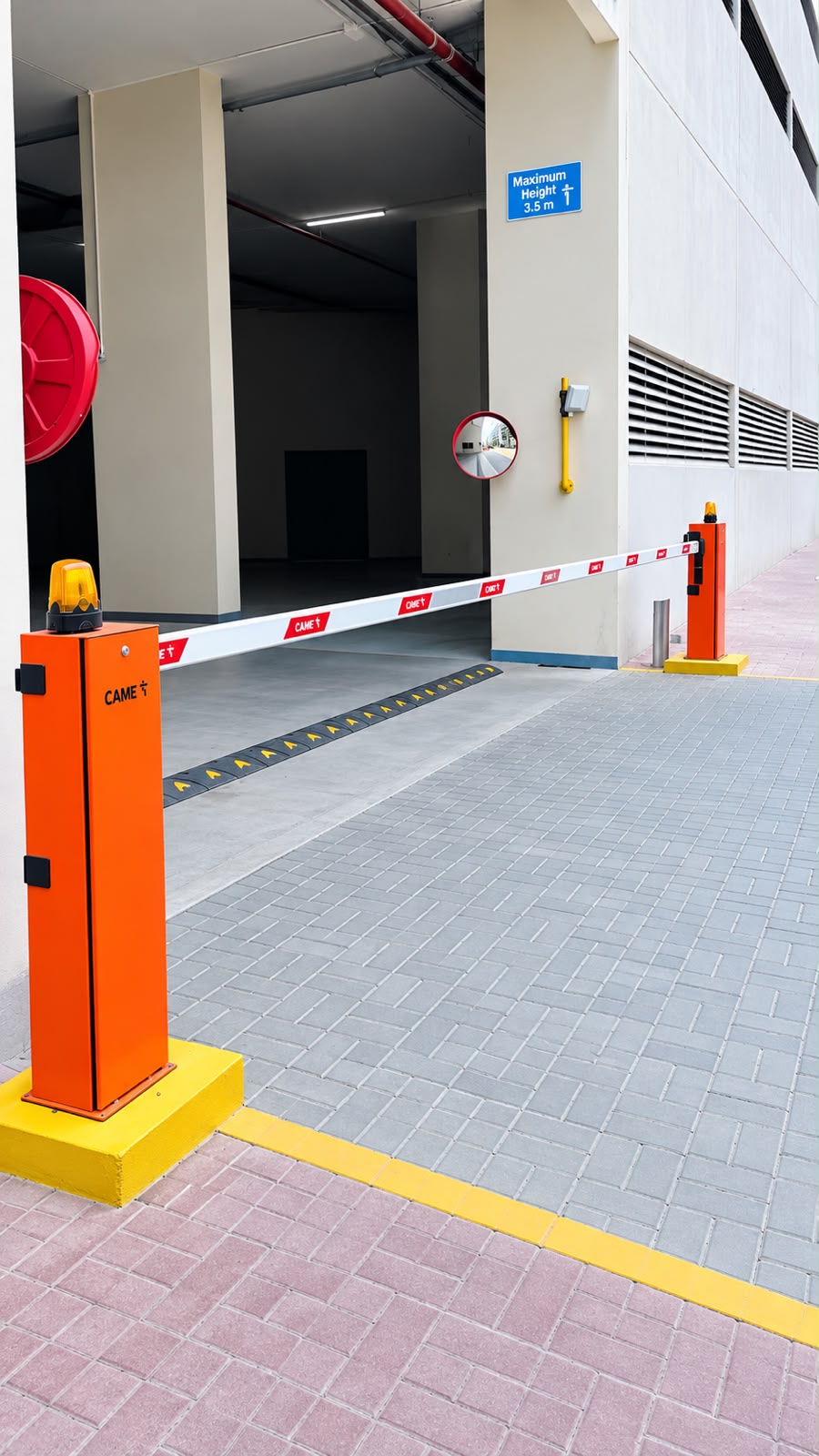
سور البوابة
حاجز مركبة أفقي منخفض ينزلق جانبيًا حيث لن يتمكن ذراع الرافعة من مسح المظلة، مع كاشفات حلقة وخلايا ضوئية وعلامة أو لوحة مفاتيح أو التحكم في التذاكر.
عرض التفاصيل -
الأعمدة الواقية
أعمدة ثابتة وقابلة للإزالة وآلية من الفولاذ أو الفولاذ المقاوم للصدأ للمداخل والممرات ومواقف السيارات، مع أشرطة عاكسة، ووصلات الإضاءة والتحكم في الوصول.
عرض التفاصيل


